Huntersville, NC: (704) 992-8100     Putnam, CT: (860) 928-7911

2026 Best PEEK Components for Global Buyers

For global buyers, selecting the right peek components in 2026 requires more than comparing prices. Material grade, dimensional tolerance, processing quality, and supplier reliability can affect every stage of a project. A component that looks suitable on a datasheet may perform poorly under continuous heat, chemical exposure, friction, or repeated sterilization. Details matter.

This guide examines practical choices for industrial, medical, electrical, aerospace, and fluid-handling applications. It considers machined seals, insulators, bearings, bushings, valve parts, and custom assemblies. Each application demands careful review of temperature limits, load conditions, surface finish, and installation space. Real conditions differ. Buyers should request technical data, inspection records, and material traceability before approving production samples.

Experienced sourcing teams also evaluate manufacturing capability, communication speed, packaging, and quality consistency. A supplier may offer excellent prototypes but struggle with stable production volumes. That weakness is easy to miss. It deserves attention. Regional standards and import requirements can also influence documentation, labeling, and delivery planning. These details should be confirmed with qualified local professionals when necessary.

The strongest purchasing decision balances engineering performance, lifecycle value, and dependable service. It does not always select the lowest quotation. Cost still matters, especially for large orders, but reliability protects schedules and reduces replacement risks. Some recommendations may need revision as new compounds, testing methods, and market conditions emerge. This guide therefore focuses on verifiable information, practical evaluation, and thoughtful comparison for buyers seeking dependable PEEK solutions in 2026.
2026 Best PEEK Components for Global Buyers

What Are PEEK Components and Why Do They Matter in 2026?

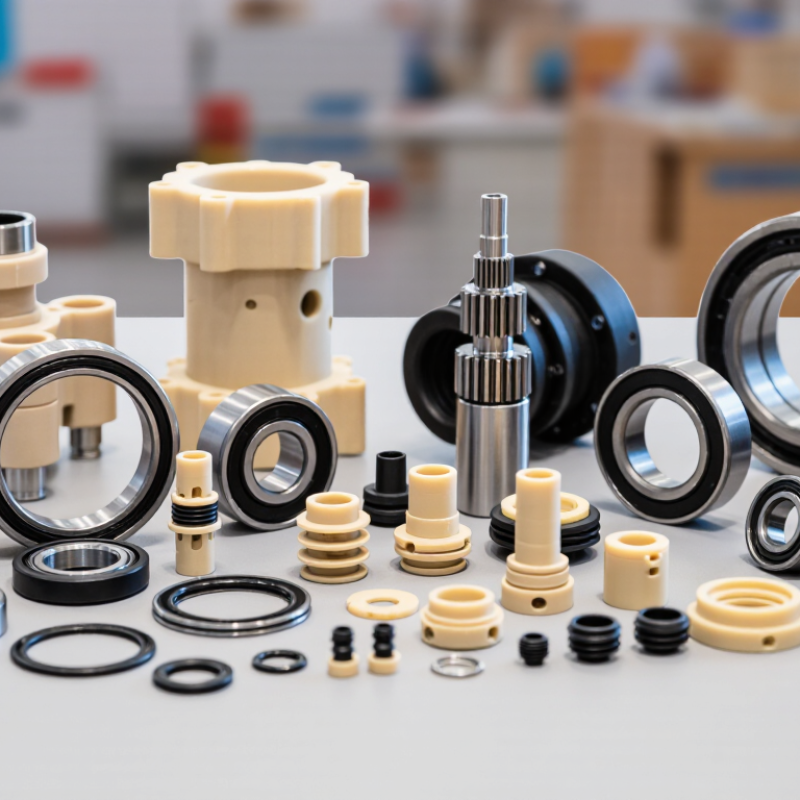
PEEK components are precision parts made from polyether ether ketone, a semi-crystalline engineering thermoplastic. They include seals, bushings, bearings, insulators, gears, and custom-machined rings. The material tolerates high temperatures, aggressive chemicals, radiation, and repeated mechanical loads. That combination matters in 2026, when equipment must become lighter, cleaner, and more reliable. Less downtime matters.

Grand View Research estimated the global PEEK market at about USD 1 billion in 2023 and forecast strong growth through 2030. MarketsandMarkets also projects sustained expansion, although its figures differ by scope and methodology. These reports reflect demand from aerospace, medical equipment, electronics, energy, and advanced manufacturing. For buyers, PEEK components can reduce lubrication needs and support compact designs. However, they are not a magic polymer.

Production experience shows several details deserve attention. Incorrect machining can create residual stress, poor tolerances, or premature cracking. Filled grades may improve stiffness or wear resistance, but they can increase tool wear and affect mating surfaces. Buyers should request material certificates, batch traceability, dimensional inspection records, and application-specific test data. Temperature limits also depend on load, geometry, exposure time, and reinforcement. A supplier’s catalog value is only a starting point. Real performance must be verified under actual operating conditions, especially when components face pressure cycles, sterilization, or chemical contact.


2026 Best PEEK Components for Global Buyers — What Are PEEK Components and Why Do They Matter in 2026?

PEEK components are precision parts made from polyether ether ketone, including seals, bearings, bushings, insulators, gears, valve seats, and custom-machined components. Their high thermal resistance makes them suitable for demanding applications. Typical unfilled PEEK has a glass-transition temperature of approximately 143°C, a melting point near 343°C, a long-term service temperature around 250°C, and a short-term service temperature of approximately 300°C. Actual performance depends on grade, reinforcement, design, and test method.

Which PEEK Component Types Serve Global Industrial Applications?

2026 Best PEEK Components for Global Buyers

Which PEEK component types serve global industrial applications? The answer depends on load, temperature, chemicals, and movement. PEEK bearings and bushings suit pumps, conveyors, and semiconductor equipment. They reduce lubrication needs in dusty or fluid-heavy environments. PEEK seals, valve seats, and backup rings support chemical processing and energy systems. Their resistance to hydrocarbons, steam, and repeated heat cycles makes them practical choices.

Electrical connectors, insulators, and cable guides serve demanding power and electronics applications. PEEK gears and wear strips fit compact automation assemblies, where low friction matters. Precision-machined manifolds and custom brackets help engineers manage complex fluid paths. Grand View Research estimates the global PEEK market could reach about USD 1.9 billion by 2030, with strong growth from medical, aerospace, and industrial uses. These figures are forecasts, not guarantees.

Material selection still needs testing. A seal that survives heat may deform under pressure. A bearing with low friction may wear faster without proper surface pairing. This is where application records and dimensional inspection matter. Buyers should request resin grade data, temperature limits, chemical-compatibility results, and batch traceability. MarketsandMarkets also reports continued demand for high-performance polymers in lightweight industrial systems. However, reports often group multiple PEEK forms together. That limitation deserves attention when comparing component suppliers. Practical trials remain essential.

How Are PEEK Components Manufactured and Quality Tested?

2026 Best PEEK Components for Global Buyers

How Are PEEK Components Manufactured and Quality Tested?

PEEK components begin with controlled resin drying. Moisture can cause bubbles, brittleness, and unstable dimensions during molding. Manufacturers typically use injection molding, compression molding, or precision CNC machining. Each method suits different geometries and production volumes. Injection molding supports repeatable complex parts. CNC machining works well for low-volume, tight-tolerance components. Annealing can reduce internal stress after machining, although it may slightly change dimensions.

Quality testing should follow the approved drawing and material specification. Inspectors check diameter, flatness, surface finish, and critical tolerances with calibrated equipment. Tensile performance can be evaluated under ASTM D638, while compression behavior may follow ASTM D695. Differential scanning calorimetry, described in ASTM D3418, helps confirm melting behavior and thermal history. According to Grand View Research’s PEEK market analysis, demand is expanding across aerospace, medical, electrical, and industrial applications. MarketsandMarkets has also identified high-temperature performance as a major growth factor.

Traceability matters. Each lot should connect resin records, machine settings, inspection results, and packaging details. A practical supplier should provide certificates, dimensional reports, and sample retention. No process is flawless. Warpage, tool wear, or inconsistent cooling can still appear. Buyers should request first-article inspection and verify critical features independently before approving volume production.

2026 Best PEEK Components for Global Buyers - How Are PEEK Components Manufactured and Quality Tested?

Manufacturing or Quality Dimension Typical Process or Requirement Representative Technical Data Recommended Verification Method Buyer Quality Checkpoint
Material Selection Select unfilled, glass-fiber-reinforced, carbon-fiber-reinforced, or wear-modified PEEK according to load, temperature, friction, and chemical exposure. PEEK is a high-performance thermoplastic with a melting temperature of approximately 343°C and a glass-transition temperature of approximately 143°C. Review the material certificate, lot number, filler content, and applicable material specification. Confirm that the selected grade matches the operating temperature, mechanical load, wear conditions, and regulatory needs.
Injection Molding Dry the resin when required, heat the barrel above the polymer melting range, fill the mold, hold pressure, cool, and eject the component. Suitable for repeat production of complex geometries and consistent high-volume parts. Mold temperature control is important because PEEK is semi-crystalline. Inspect first-off samples, process records, dimensions, flash, sink marks, weld lines, and crystallinity-related appearance. Require an approved drawing, control plan, process parameters, and capability data for critical dimensions.
CNC Machining Machine PEEK semi-finished stock using sharp, suitable cutting tools, controlled feeds, adequate chip removal, and staged finishing passes. Preferred for prototypes, low-volume production, tight tolerances, and geometries that are difficult to mold. Use calibrated gauges, coordinate-measuring equipment, surface-finish instruments, and visual inspection for burrs or machining damage. Check dimensional stability after machining and, where relevant, after conditioning at the intended service temperature.
Compression Molding Place PEEK material in a heated mold, apply pressure, consolidate the material, and cool under controlled conditions. Can be useful for larger, thicker, or relatively simple components and for selected reinforced formulations. Evaluate density, voids, warpage, thickness, surface condition, and internal structure when required. Define the allowable void level, flatness, shrinkage, and post-molding machining allowance.
Additive Manufacturing Use a qualified high-temperature additive process with controlled chamber temperature, build orientation, and thermal history. Appropriate mainly for prototypes, customized parts, and complex low-volume geometries; properties may vary by build direction. Inspect layer adhesion, porosity, dimensional accuracy, surface finish, and anisotropic mechanical performance. Request orientation-specific test data when the component carries structural or pressure-related loads.
Dimensional Inspection Measure critical dimensions, geometric tolerances, concentricity, flatness, perpendicularity, and hole locations against the approved drawing. Tolerance capability depends on part size, geometry, process, filler content, and thermal conditioning; no universal tolerance applies to every PEEK component. Use calibrated CMMs, optical measurement systems, micrometers, gauges, and documented sampling plans. Ensure measurement uncertainty is suitable for the specified tolerance and retain inspection records by production lot.
Mechanical Testing Test representative specimens or finished parts for tensile, flexural, compressive, impact, or hardness performance as applicable. Unfilled PEEK commonly exhibits tensile strength in the approximate range of 90–100 MPa, while reinforced grades can be higher; actual values depend on grade and test conditions. Use ASTM D638 for tensile properties, ASTM D790 for flexural properties, and other applicable ASTM or ISO methods. Compare results with the approved material datasheet and test at the temperature and conditioning state relevant to service.
Thermal Performance Confirm that the component maintains required strength, dimensions, and function throughout the specified temperature range. PEEK has a continuous-use temperature often reported near 250°C in suitable environments, but the allowable value depends on load, duration, atmosphere, and grade. Use DSC for melting and crystallization behavior, TGA for thermal stability, and heat-deflection or long-term aging tests when applicable. Request a temperature-life assessment for applications involving sustained load or repeated thermal cycling.
Chemical Resistance Evaluate exposure to oils, fuels, hydraulic fluids, solvents, acids, bases, steam, and cleaning agents used in the application. PEEK has broad resistance to many chemicals, but concentrated acids, strong oxidizers, and high-temperature exposure can cause degradation. Conduct immersion or exposure testing and measure mass, dimensions, appearance, hardness, and mechanical-property changes. Use the actual fluid, concentration, temperature, pressure, and exposure duration whenever possible.
Wear and Friction Testing Assess sliding, abrasion, lubrication, counterface material, contact pressure, speed, and temperature. Wear behavior is application-specific; carbon-fiber, glass-fiber, graphite, or other modified formulations may be selected for different tribological requirements. Use a documented pin-on-disc or component-level test with controlled load, speed, environment, and counterface. Specify allowable wear rate, friction behavior, mating-material compatibility, and inspection frequency.
Surface Finish and Appearance Control tool marks, weld lines, flow marks, scratches, burrs, discoloration, contamination, and molding defects. The required surface finish depends on sealing, sliding, optical, cleanliness, and assembly requirements. Use visual standards, surface-roughness measurement, and functional fit or sealing tests. Define acceptance samples and numerical roughness limits for all functional surfaces.
Cleanliness and Packaging Remove chips and residues, protect precision surfaces, and package parts against moisture, dust, impact, and deformation during transport. Packaging requirements vary from standard industrial protection to controlled-cleanliness packaging for medical, semiconductor, or vacuum applications. Perform visual cleanliness inspection, particle testing, or extractables testing when specified by the application. Verify quantity, part identification, lot traceability, protective materials, and packaging integrity before shipment.
Traceability and Documentation Maintain traceability from raw-material lot through processing, inspection, packing, and shipment. A complete quality file may include drawings, material certificates, inspection reports, process records, nonconformance records, and certificates of conformity. Audit document control, calibration status, inspection sampling, corrective actions, and change-management records. Require a defined approval process for changes to material, tooling, suppliers, process parameters, or inspection methods.

Note: Technical values shown are representative ranges or commonly reported reference values. Final acceptance criteria should be defined by the approved drawing, material specification, application conditions, and applicable test standard.

What Standards Guide PEEK Component Selection and International Supply?

2026 Best PEEK Components for Global Buyers

PEEK component selection should begin with application risk, not price. Material data sheets alone rarely answer that question. ASTM D6262 guides specifications for PEEK molding and extrusion materials, including mechanical and thermal requirements. ASTM D638 and ISO 527 support tensile testing, while ISO 178 evaluates flexural performance. These standards make supplier comparisons more practical.

A 2024 analysis by Grand View Research estimated the global PEEK market at approximately USD 1.1 billion in 2023, with strong growth expected through 2030. Demand is rising in aerospace, medical equipment, electronics, and chemical processing. However, market growth does not guarantee consistent component quality. It can hide differences in grade, filler content, machining tolerance, and test conditions. Specifications can be misunderstood.

USD 1.1 billion
in 2023

International buyers should request batch-level certificates, dimensional inspection records, and processing history. For implant-related applications, ASTM F2026 and ISO 10993 may become relevant, depending on the intended use and regulatory pathway. ISO 9001 certification supports quality control, but it does not replace product-specific testing. The ISO Survey 2022 recorded more than 1.2 million ISO 9001 certificates worldwide, showing broad adoption but not identical manufacturing capability.

Supply documents should also define packaging, moisture protection, traceability, and acceptance limits. A component may meet a material standard yet fail in a thin-wall seal or high-cycle bearing. That practical gap matters. Procurement teams should validate real samples under working temperature, load, chemicals, and sterilization exposure before approving international production.

How Can Global Buyers Evaluate PEEK Component Suppliers?

2026 Best PEEK Components for Global Buyers

How Can Global Buyers Evaluate PEEK Component Suppliers?

Global buyers should assess PEEK suppliers beyond price and catalog range. The material market is expanding. Grand View Research’s 2024 Polyether Ether Ketone Market report projects a 9.5% annual growth rate from 2024 to 2030. This growth attracts new processors, but experience still matters. Ask for resin batch traceability, processing records, and certificates linked to each shipment. A polished website proves little.

Check manufacturing control with measurable evidence. Suppliers should provide dimensional inspection reports, thermal-processing parameters, and test methods for tensile strength, wear, and chemical resistance. ISO 9001 certification supports quality management, while ISO 13485 may matter for medical applications. MarketsandMarkets estimated the PEEK market at about USD 1 billion in 2023. That figure suggests strong demand, not automatic supplier reliability. Request samples from different production lots.

Supply continuity deserves equal attention. Review lead times, approved raw-material sources, mold ownership, and contingency plans. For precision seals, bushings, or insulating parts, confirm tolerances under real temperature cycles. A supplier may quote a tight tolerance that fails after machining or sterilization. I would also examine packaging details, including sealed bags, moisture protection, and clear lot labels. Paperwork can be incomplete. That is a warning, not a minor inconvenience. A site audit, even a remote one, often reveals whether technical claims match daily production practice.