Best Carbon Peek Material Properties for Your Next Project?
When selecting materials for engineering projects, understanding material properties is crucial. Carbon peek material properties stand out due to their exceptional performance. This thermoplastic boasts superior chemical resistance, heat stability, and low friction characteristics. These traits make it an ideal choice for demanding applications.
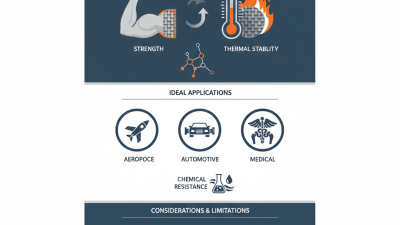
The unique attributes of carbon peek can enhance projects in various industries. For instance, aerospace, automotive, and medical sectors utilize this material for its reliability and strength. However, it's important to acknowledge potential challenges. The processing techniques for carbon peek can be complex and costly. Careful consideration is necessary to ensure the right approach for your specific needs.
In essence, exploring carbon peek material properties is essential. This knowledge allows for informed decision-making, ultimately leading to successful project outcomes. Taking the time to understand these properties may reveal both opportunities and limitations in your design process.

Overview of Carbon Peek Material and Its Applications
Carbon PEEK, short for polyether ether ketone, is a high-performance thermoplastic. Its unique properties make it ideal for various applications. The material is lightweight yet exceptionally strong. It withstands high temperatures, often up to 250°C. This heat resistance is crucial in fields like aerospace and automotive.
In medical technology, Carbon PEEK shines due to its biocompatibility. It’s used in implants and prosthetics. Additionally, the material’s chemical resistance makes it a reliable choice in corrosive environments. Industries involved in oil and gas often rely on Carbon PEEK for its durability.
Despite its many advantages, Carbon PEEK also presents challenges. Its high processing temperatures require specialized equipment, which can increase project costs. Moreover, the material’s availability may be limited, leading to potential delays. Understanding these factors is essential for making informed decisions in material selection.
Best Carbon Peek Material Properties for Your Next Project
This chart illustrates the key properties of Carbon Peek material, commonly used in engineering and manufacturing applications. The parameters shown include tensile strength, flexural strength, impact strength, tensile modulus, and heat deflection temperature. These properties highlight the material's suitability for high-performance applications.
Key Physical Properties of Carbon Peek: Strength and Durability
Carbon Peek, a high-performance thermoplastic, boasts impressive strength and durability. This material is often chosen for demanding applications. Its tensile strength is remarkable, making it suitable for structural components. Carbon Peek performs well in extreme temperatures, maintaining integrity in both hot and cold conditions.
Durability is another standout feature of Carbon Peek. It resists wear and tear, making it ideal for components in harsh environments. This material also exhibits excellent chemical resistance. Despite its advantages, it can be challenging to process. Molding and machining require specialized techniques. Users must be cautious about these potential difficulties.
Understanding the physical properties of Carbon Peek is crucial for any project. The balance between strength and weight makes it a preferred choice for engineers. However, it may not always be the most cost-effective option. Considerations of budget versus performance often arise. Evaluating the specific needs of a project is essential to fully appreciate Carbon Peek’s benefits.
Best Carbon Peek Material Properties for Your Next Project
| Property |
Value |
| Tensile Strength |
90 MPa |
| Flexural Strength |
155 MPa |
| Elongation at Break |
2% |
| Hardness (Shore D) |
80 |
| Density |
1.43 g/cm³ |
| Service Temperature |
-40 to 260 °C |
| Thermal Conductivity |
0.25 W/m·K |
| Chemical Resistance |
Excellent |
Thermal Performance Characteristics of Carbon Peek Materials
Carbon Peek materials exhibit impressive
thermal performance characteristics. These materials can withstand temperatures exceeding
300°C in continuous use, maintaining structural
integrity under heat stress. This allows for applications in extreme environments,
such as aerospace and automotive sectors. Moreover, they showcase a low thermal conductivity
rate of around 0.25 W/m·K, which is beneficial for thermal
insulation purposes.
The thermal expansion coefficient for carbon Peek is significantly low, approximately
10.4 µm/m·K, demonstrating minimal
expansion under heating. This characteristic is crucial when precision components
must maintain dimensional stability in diverse thermal conditions. Reports indicate that carbon
Peek maintains 80% of its mechanical properties even after prolonged
exposure to high temperatures.
While carbon Peek offers remarkable benefits, it is not without challenges. The
cost of carbon Peek can be higher than traditional materials,
posing budget considerations for projects. Furthermore, machining
carbon Peek requires specialized tools due to its hardness.
Assessing both the benefits and drawbacks is essential for a successful material choice.
Chemical Resistance of Carbon Peek: Benefits and Limitations
Carbon Peek is known for its impressive chemical resistance, making it a popular choice in various industrial applications. This polymer can withstand harsh environments. It is resistant to many acids and solvents, which contributes to its durability. This resistance makes it ideal for aerospace and automotive components. However, not all chemicals are compatible with Carbon Peek. Some strong oxidizers can degrade its structure over time.
The versatility of Carbon Peek is a double-edged sword. While it performs well in many situations, there are limitations. For example, its performance can be compromised in temperatures above its thermal limits. Users must also be cautious in selecting applications, as certain chemical combinations might not be safe. Testing and validation are crucial steps before finalizing material choices.
Adopting Carbon Peek requires careful consideration. Understanding the specific chemical environment is vital. Engineers should not overlook potential risks. Relying solely on its resistance without thorough testing may lead to unforeseen issues. Balancing its benefits with possible challenges allows for more informed decisions in your next project.
Selecting the Right Carbon Peek Grade for Your Project Needs
Selecting the right carbon PEEK grade is crucial for any project involving high-performance materials. Various grades are tailored for specific applications, impacting thermal, mechanical, and chemical resistance. Understanding properties such as tensile strength, thermal conductivity, and wear resistance can help you gauge which grade aligns with your needs.
For instance, some grades excel in high-temperature environments. Others are better suited for electrical applications or surface hardness. It's important to consider the operational environment your project will face. Will it deal with extreme temperatures or harsh chemicals? If so, you must match these requirements with the appropriate PEEK grade.
Navigating these options can be overwhelming. It's easy to overlook important specifications. Taking the time to analyze your project’s demands might save you from costly rework. Often, a project that seems straightforward could require a more advanced material than expected. Be sure to consult with knowledgeable experts or data sheets for guidance. Your choice should reflect both performance and cost efficiency.