How to Choose the Right Peek Plastic for Your Project Needs?
Choosing the right peek plastic for your project is crucial. It can impact performance and longevity. Dr. Emily Carter, a leading expert in polymer science, emphasizes, "Selecting the appropriate peek plastic can make or break your project."
Peek plastic offers exceptional strength and thermal stability. However, not all types are suitable for every application. Some industries demand specific properties, such as chemical resistance or electrical insulation. Understanding these needs is essential.
Many face challenges when selecting peek plastic. The variety of options can be overwhelming. Often, users might overlook critical specifications. This oversight can lead to costly mistakes down the line. It’s important to reflect on your project requirements carefully. Make informed decisions. Your choice of peek plastic could be the key to success.
Understanding Peek Plastics and Their Characteristics
Peek plastics, or polyether ether ketone, are renowned for their exceptional properties. They combine high strength with excellent temperature resistance. This makes them an ideal choice for various applications, especially in challenging environments. They can withstand high pressures and corrosive substances. This durability is crucial in industries like aerospace and automotive.
Understanding the characteristics of peek plastics is essential. They possess low friction and wear rates, enhancing performance in moving parts. Additionally, peek plastics feature high-dimensional stability. This means they maintain their shape under stress. However, working with these materials requires careful consideration. Their processing can be tricky and may need specialized equipment. It’s important to reflect on whether the benefits outweigh these challenges.
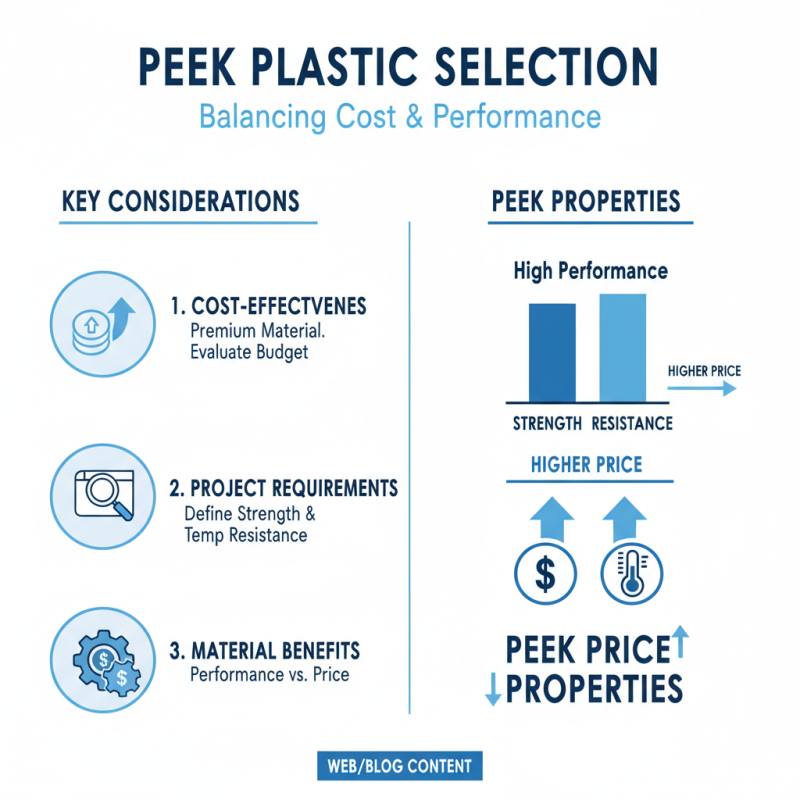
Another aspect to consider is the cost factor. Peek plastics are not the cheapest option available. When planning a project, it’s vital to weigh your budget against your needs. You might find that alternative materials serve your purpose adequately. If performance is critical, however, peek may be your best bet. Assessing your specific requirements will guide you in making the right decision.
How to Choose the Right Peek Plastic for Your Project Needs?
| Characteristic |
Description |
Typical Applications |
| Temperature Resistance |
Stable at high temperatures up to 260°C (500°F) |
Aerospace, automotive, oil and gas |
| Chemical Resistance |
Resistant to acids, bases, and solvents |
Chemical processing, pharmaceuticals |
| Mechanical Strength |
High tensile strength and rigidity |
Medical devices, industrial components |
| Electrical Insulation |
Excellent electrical insulating properties |
Electronics, connectors |
| Wear Resistance |
High resistance to wear and abrasion |
Bearing applications, bushings |
Evaluating Project Requirements for Material Selection
When selecting the right Peek plastic for your project, evaluating specific requirements is essential. Consider mechanical properties, temperature resistance, and chemical compatibility. According to a 2021 industry report, Peek showcases impressive tensile strength, often exceeding 90 MPa. This makes it suitable for demanding environments, such as aerospace or automotive industries.
Another crucial aspect is thermal stability. Peek can withstand temperatures up to 260 degrees Celsius. However, not every application requires such high heat resistance. Sometimes, a lower grade may suffice. This could save costs and resources. A 2022 materials study indicated that nearly 30% of projects over-specify materials, leading to unnecessary expenses.
Chemical resistance is vital, too. Peek is resistant to a wide range of substances. Still, there are exceptions. In environments with strong acids, it may not perform optimally. Users should conduct thorough compatibility tests before making a final decision. Often, it's the overlooked details that affect performance. This ensures the selected plastic meets the specific demand and optimizes the project outcome.
How to Choose the Right Peek Plastic for Your Project Needs?
This bar chart evaluates the key properties of Peek plastic to help you determine its suitability for your project needs. The properties measured include flexural strength, tensile strength, impact resistance, chemical resistance, and thermal stability, providing a comprehensive overview of its performance characteristics.
Comparing Different Grades of Peek Plastic
When selecting the right grade of PEEK plastic for your project, understanding the differences is crucial. PEEK comes in various grades, each tailored for specific applications. Some are designed for high-temperature resistance. Others offer enhanced chemical resistance. This makes it essential to align your choice with project demands.
High-performance grades can withstand extreme conditions. However, they may not be necessary for simpler tasks. Sometimes, using a lower-grade PEEK can save costs without sacrificing quality. Always ponder your project's true requirements. Consider the environment where the plastic will function. Is it under constant stress? Does it face harsh chemicals?
Keep in mind that not all PEEK grades perform equally in every scenario. Test samples before committing. This practice often reveals surprises. The final choice should reflect both performance needs and budget constraints. Take a moment to reflect on these aspects. Your project deserves the right materials, tailored to its specific needs.
Best Practices for Processing and Fabricating Peek Plastic
Processing and fabricating PEEK plastic requires attention to detail and an understanding of best practices. PEEK, or polyetheretherketone, is known for its high strength, chemical resistance, and temperature stability. According to industry reports, PEEK can withstand temperatures up to 480°F, making it ideal for high-performance applications. However, improper handling can lead to defects.
Cutting and machining PEEK should be done with precise tools. A study from a leading materials research journal indicates that using sharp, carbide-tipped cutters can reduce wear and minimize chip formation. This can enhance the finished product's quality and precision. Excessive heat during machining may lead to warping or melting. Therefore, using coolant or reduced speeds is essential.
Injection molding and 3D printing PEEK plastic also require careful consideration. The temperature settings must align with PEEK's thermal properties. Yet, achieving the right balance can be challenging. Many engineers report difficulties in attaining consistent results. Understanding the nuances of each method will help avoid common pitfalls. Proper preparation and experimentation can lead to better outcomes.