What is the Coefficient of Thermal Expansion for PEEK?
The coefficient of thermal expansion PEEK is a critical property in material science. Dr. Emily Carter, an expert in polymer engineering, emphasizes its significance: "Understanding the coefficient of thermal expansion PEEK is vital for reliable applications." This insight reveals how PEEK responds to temperature changes, impacting its performance.
As industries increasingly rely on PEEK, knowing its thermal expansion becomes essential. This polymer exhibits a relatively low coefficient, making it stable under temperature fluctuations. Such stability is crucial in aerospace and medical devices, where precision is paramount.
However, many engineers lack awareness of this property. It can lead to design flaws and material failures. Some may assume all polymers perform similarly, which is misleading. Thus, comprehensive knowledge about the coefficient of thermal expansion PEEK is necessary for optimal application.
Definition of Coefficient of Thermal Expansion (CTE) in Materials
The coefficient of thermal expansion (CTE) is a crucial property of materials. It quantifies how much a material expands when heated. This property is important in applications involving temperature changes. For instance, metals expand significantly, while ceramics expand less. Understanding CTE helps engineers make better design choices.
PEEK, a high-performance polymer, has a specific CTE value. It expands with temperature changes, but to a lesser extent than many metals. This characteristic makes PEEK suitable for high-temperature environments, like aerospace and automotive applications. When materials expand unevenly, it can lead to stress and deformation. This can be a potential failure point.
Tips: When selecting materials, always consider their CTE. A mismatch in thermal expansion can lead to issues. Ensure that the materials will perform well together. It's a simple detail but can save time and resources in the long run.
Coefficient of Thermal Expansion (CTE) for PEEK
| Material |
Coefficient of Thermal Expansion (CTE) [µm/(m·K)] |
Temperature Range [°C] |
| PEEK (Polyether ether ketone) |
50-60 |
-40 to 250 |
| PTFE (Polytetrafluoroethylene) |
100-140 |
-200 to 260 |
| Polycarbonate |
65-70 |
-40 to 120 |
| Nylon 6 |
80-90 |
-40 to 100 |
| Polypropylene |
110-130 |
-20 to 100 |
CTE Value for Polyether Ether Ketone (PEEK) in Various Temperatures
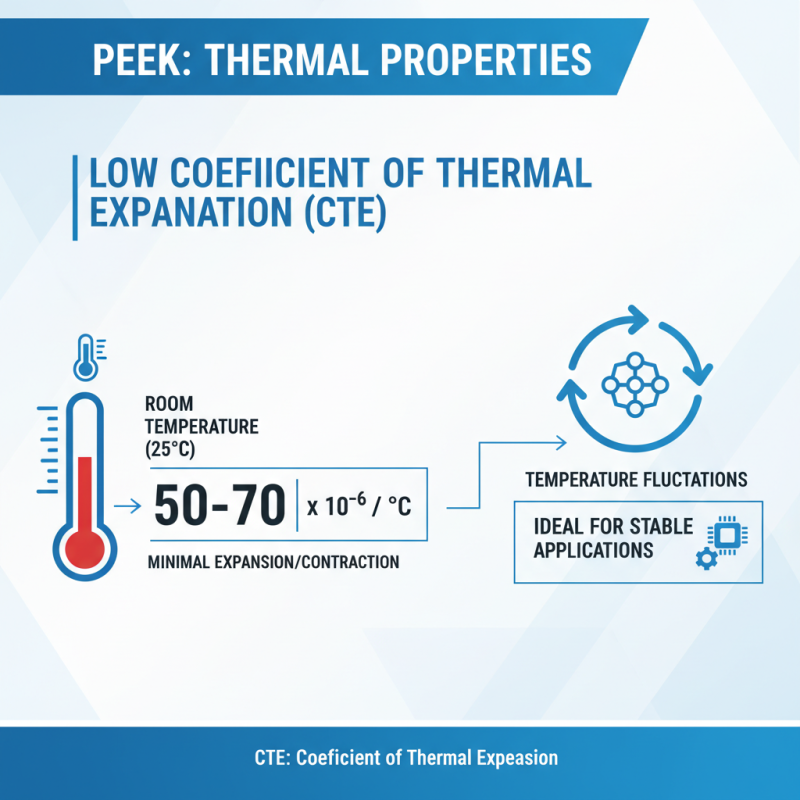
Polyether Ether Ketone, commonly known as PEEK, exhibits unique thermal properties. Its Coefficient of Thermal Expansion (CTE) varies with temperature changes. At room temperature, the CTE for PEEK is approximately 50-70 x 10^-6/°C. This low CTE indicates that PEEK expands and contracts minimally with temperature fluctuations.
As temperatures rise, the CTE for PEEK increases. For example, at elevated temperatures of around 100°C, the value can reach about 80-90 x 10^-6/°C. This means that PEEK components will experience more significant dimensional changes. It is essential to consider these variations in applications where precision is critical.
Design engineers often overlook thermal expansion properties. This can lead to fitting issues in assemblies. It's crucial to test PEEK components under expected operating temperatures. Understanding CTE helps ensure proper functionality over time.
Factors Influencing the CTE of PEEK During Thermal Expansion
The coefficient of thermal expansion (CTE) for PEEK is influenced by various factors. One significant factor is temperature. As temperature increases, materials, including PEEK, tend to expand. This expansion can lead to dimensional changes in applications. If the heat is not evenly distributed, this can create internal stresses. Such stresses may ultimately affect the structural integrity of the product.
Another factor impacting the CTE of PEEK is the material's molecular structure. PEEK has a semi-crystalline structure, which means that how tightly the polymer chains are packed can vary. Different processing methods may also alter this structure. For instance, if PEEK is processed under high pressure, it may exhibit different expansion properties compared to standard conditions. Variations in crystallinity can make predicting thermal behavior tricky.
Humidity and environmental conditions are also critical. PEEK may absorb moisture over time, which can change its thermal expansion characteristics. It's essential to consider these variables when using PEEK in specific applications. Unexpected changes in CTE can have serious implications on performance. Engineers must be aware of these factors to ensure reliability and efficiency in their designs.
Comparison of PEEK's CTE with Other Engineering Plastics
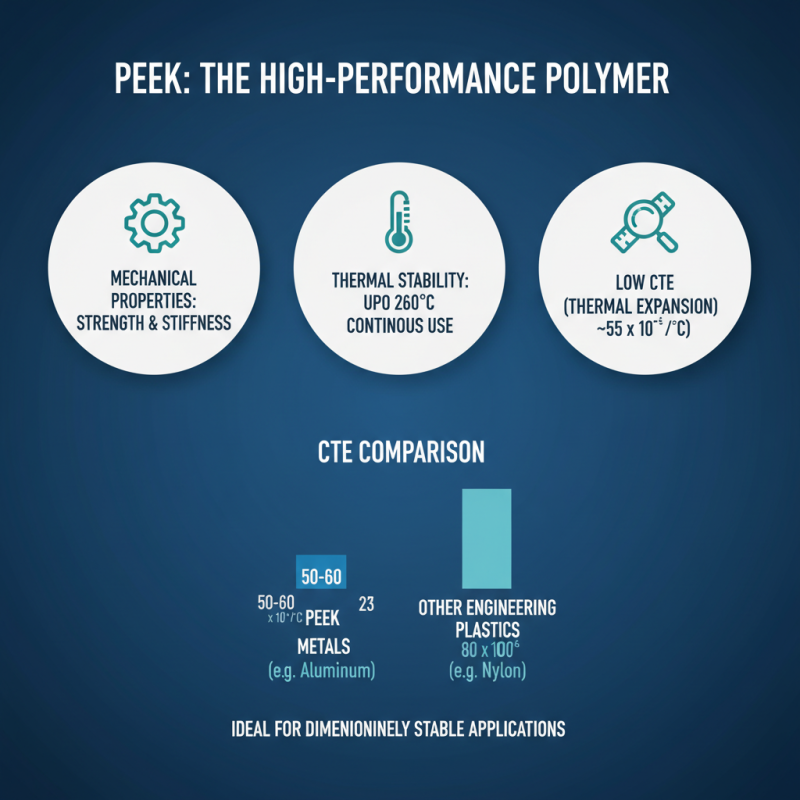
PEEK, or polyether ether ketone, is renowned for its thermal stability and mechanical properties. Its coefficient of thermal expansion (CTE) is relatively low, typically around 50 to 60 x 10^-6/°C. This makes it an excellent choice for applications requiring dimensional accuracy across temperature variations. However, when compared to other engineering plastics, PEEK's CTE is somewhat moderate.
For instance, polytetrafluoroethylene (PTFE) has a higher CTE, ranging from 100 to 200 x 10^-6/°C. This can lead to significant dimensional changes under temperature fluctuations. Meanwhile, polypropylene often exhibits a CTE of about 100 to 150 x 10^-6/°C. Such differences highlight the need for careful material selection based on thermal expansion characteristics.
It's also important to consider that while PEEK performs well under certain conditions, it may not always be the best option. Other materials can provide better thermal expansion performance depending on the application. The choice of material must take into account not only CTE but also long-term operational demands and environmental factors. Balancing these aspects can be challenging, but it is crucial for effective engineering solutions.
Applications of PEEK Based on Its Thermal Expansion Characteristics
PEEK, a high-performance polymer, exhibits notable thermal expansion characteristics. Its coefficient of thermal expansion (CTE) is relatively low, making it suitable for various applications. This property is crucial in environments experiencing fluctuating temperatures.
Industries using PEEK benefit from its resistance to thermal stress. In aerospace, PEEK components maintain stability during temperature shifts. In automotive applications, PEEK ensures reliable performance in high-temperature settings. This stability enhances the durability of parts, reducing the likelihood of failures.
Tips: When selecting materials, consider thermal expansion data. Understanding CTE can prevent issues in assembly and performance. Always test in relevant conditions for your specific application.
Prioritizing this aspect can save time and costs later on. Use PEEK where thermal stability is essential for functionality.