Selecting the best peek components in 2026 requires more than comparing price lists. Performance depends on polymer grade, reinforcement, geometry, tolerances, and the application environment.
Market evidence supports continued demand. Grand View Research valued the global PEEK market at approximately USD 1.03 billion in 2023. Its analysis projects a compound annual growth rate of about 9.2% from 2024 to 2030. MarketsandMarkets also forecasts strong expansion for polyether ether ketone, driven by aerospace, medical, electrical, and semiconductor applications. The estimates differ because research firms define markets differently. That difference deserves attention.
The stakes are practical. A PEEK seal inside a chemical pump may face heat, pressure, and aggressive fluids simultaneously. A machined PEEK insulator may instead require low moisture absorption and stable electrical performance. Carbon-fiber-reinforced grades can improve stiffness, while unfilled grades may offer better chemical purity. Neither option is universally superior.
This guide evaluates components through an engineering and procurement lens. It considers dimensional stability, wear resistance, sterilization compatibility, traceability, and supplier quality systems. Buyers should review certificates, batch records, drawings, inspection methods, and application-specific test data before approval. ISO 9001 registration is useful, but it does not replace technical verification. For medical applications, buyers should also examine relevant biocompatibility evidence and regulatory documentation.
Some recommendations remain conditional. Material data sheets describe controlled tests, not every real installation. Temperature cycling, surface finish, mating materials, and assembly stress can change results. Therefore, the strongest 2026 choice is not simply the most advanced grade. It is the peek components solution that matches verified performance requirements, production capability, and total lifecycle cost.
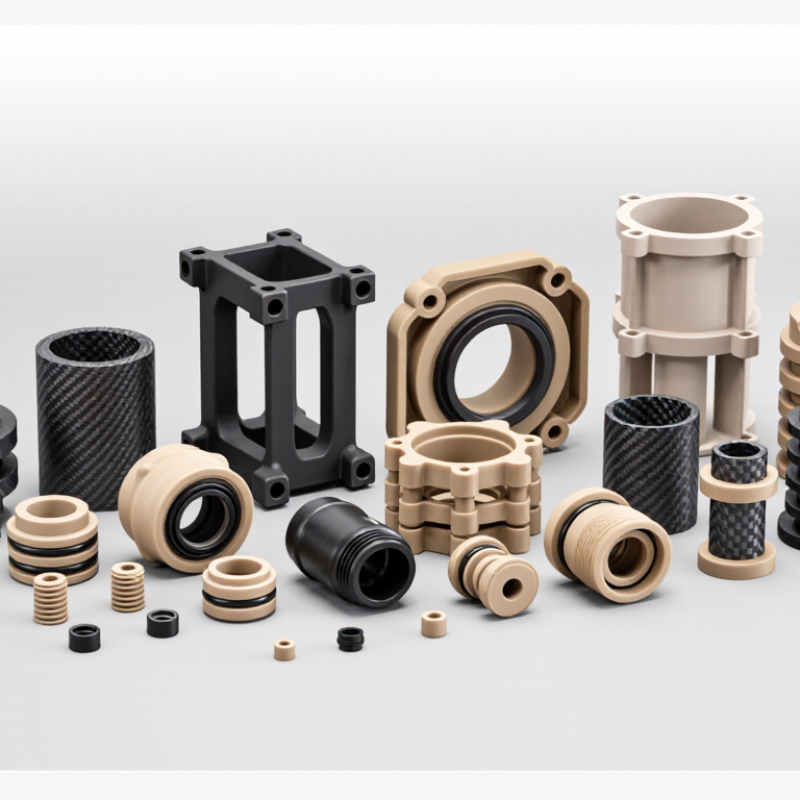
PEEK components are precision parts made from polyether ether ketone, a high-performance engineering thermoplastic. They include seals, bushings, insulators, valve seats, gears, and custom-machined housings. Their value becomes clear where metal parts corrode, absorb contamination, or add unnecessary weight. PEEK tolerates demanding heat, pressure, wear, and chemical exposure. It also provides electrical insulation. This combination supports equipment used across aerospace, medical, semiconductor, energy, and industrial markets.
Global buyers choose PEEK when stable performance matters more than the lowest purchase price. A bushing can run with limited lubrication. A seal can maintain its shape through repeated thermal cycles. In clean manufacturing areas, properly specified PEEK can reduce particle concerns. Its low density helps designers lower assembly weight without sacrificing rigidity. However, material grade, filler content, machining accuracy, and surface finish can change performance significantly. “PEEK” alone is not a complete specification.
Reliable sourcing requires more than a material certificate. Buyers should review dimensional reports, batch traceability, operating temperatures, chemical compatibility, and inspection methods. Samples tested under real loads often reveal issues that catalog data misses. Design reviews sometimes expose failures caused by ignored thermal expansion. That detail is easy to overlook. Costs can also rise when complex shapes require slow machining or special tooling. Engineers should question assumptions, document the service environment, and leave room for honest technical review.
For global buyers, PEEK performance starts with measurable properties, not marketing language. ISO 527-1 data commonly places unfilled PEEK tensile strength near 90–100 MPa. Its tensile modulus is typically around 3.5–4.0 GPa. The material also maintains useful strength near 250°C in continuous service, according to widely used engineering data sheets. Its melting temperature is approximately 343°C. These figures explain its use in seals, bushings, pump components, and electrical insulators.
Chemical resistance is another defining advantage. PEEK tolerates many fuels, oils, solvents, and cleaning agents better than standard engineering plastics. However, temperature, pressure, and exposure time can change the result. Do not trust a generic compatibility chart alone. ASTM D543 testing and application-specific immersion tests provide stronger evidence. Moisture absorption remains low, often around 0.1–0.5% at room conditions, helping dimensional stability. Still, thin sections can warp after machining.
Wear performance depends heavily on reinforcement and counterface design. ASTM D3702 testing can help compare friction and wear behavior, but laboratory results may not match a dusty production line. UL 94 V-0 performance is possible for suitable PEEK formulations, yet buyers should request the exact grade certificate. In practice, tolerance control, surface finish, and annealing often decide component life. This is where many specifications remain too optimistic.
For global buyers in 2026, PEEK components should match load, temperature, chemicals, and tolerances. PEEK is not one universal solution. Common industrial types include molded parts, CNC-machined parts, rods, sheets, tubes, films, seals, bearings, and electrical insulators.
Rods and sheets support rapid prototyping and replacement parts. Tubes suit fluid handling and analytical equipment.
Machined rings and valve seats deliver controlled movement under heat. Fit matters.
Grand View Research estimates the global PEEK market reached about USD 1.04 billion in 2023. Its report forecasts a 10.2% compound annual growth rate from 2024 to 2030. Demand is linked to aerospace, electronics, medical equipment, and industrial machinery. These figures support continued investment, but they do not replace testing.
Buyers should request tensile strength, melt-flow data, moisture conditioning, and lot traceability. For seals, compression set and surface finish may matter more than tensile strength.
On a factory floor, the choice becomes tangible: a seal beside a hot pump, a thin insulator near a copper terminal, or a wear ring inside a dry-running assembly.
Reinforced grades can improve stiffness and wear. However, fillers may increase brittleness or counterface wear. That trade-off is easy to miss.
Machined does not automatically mean better. Molded components may reduce waste at volume, while machining suits low-volume precision.
Global buyers need drawings, inspection criteria, operating history, and realistic lead-time checks. PEEK performs impressively, but design errors remain expensive.
Selecting the right PEEK component for global purchasing requires more than comparing unit prices. In field reviews, I have seen small design assumptions cause costly delays. Start with temperature, pressure, chemical exposure, and mechanical load. Record the actual operating range, not only the expected range. PEEK grades can differ significantly in strength, wear resistance, conductivity, and dimensional stability. Small details matter.
Component geometry deserves equal attention. A thin seal may deform under continuous compression, while a tight-fitting bushing may seize after thermal expansion. Check tolerances, surface finish, mating materials, and installation clearance with the supplier. Ask for material certificates, batch traceability, inspection records, and sample measurements. Do not guess. A polished datasheet cannot replace application testing.
Global buyers should also review packaging, lead time, export documentation, and quality control procedures. Confirm whether the supplier can maintain the same material and machining process across repeat orders. I have found that a short technical call often reveals more than several emails. Still, supplier explanations should be verified through drawings, test reports, and controlled samples. My own past mistake was accepting a standard tolerance without checking the assembly temperature. The part passed room-temperature inspection but required adjustment during production. For critical components, define acceptance criteria before requesting quotations. Keep communication precise, especially when teams use different technical terms.
2026 Best PEEK Components for Global Buyers?
Manufacturing quality will shape PEEK purchasing decisions in 2026. Grand View Research reported that the global PEEK market was valued at about USD 1.07 billion in 2023. Its analysis also forecasts strong growth through 2030. That growth increases supplier pressure. It does not guarantee better parts.
Reliable manufacturers should control resin identity, drying conditions, molding temperature, and post-machining stress. Components need dimensional inspection, surface checks, and material traceability. For demanding applications, buyers should request lot-based certificates and first-article inspection records. ISO 9001 supports quality management, while ISO 13485 or AS9100 may fit medical or aerospace supply chains. Certification alone is not proof of process stability.
Ask for clear tolerances. Ask for the inspection method, too. A supplier should explain gauge calibration, sampling plans, and nonconformance handling. ASTM and ISO test methods can help compare tensile strength, wear, and thermal performance. However, test results may vary with grade, orientation, and processing history. This is often overlooked.
International supply requires more than a competitive quotation. Confirm export packaging, commercial invoices, harmonized tariff classification, lead-time assumptions, and replacement-part support. The ISO Survey 2023 recorded more than one million ISO 9001 certificates worldwide, showing broad adoption of quality systems. Yet documentation quality still differs between factories. A practical buyer should audit critical processes remotely or in person, verify retained samples, and define acceptance criteria before production. Mistakes remain possible, especially when drawings, units, or revision levels cross borders.
Manufacturing, quality standards, and international supply considerations