
What is the best PEEK material for 2026? The answer depends on the application, not on one universal grade. A bearing inside a high-temperature pump needs different performance from a spinal implant or an electrical connector. That distinction matters as industries demand longer service life, lower maintenance, and tighter dimensional control.
Grand View Research reports that the global PEEK market is expanding steadily, supported by aerospace, automotive, electronics, and medical applications. Fortune Business Insights also forecasts continued market growth through the early 2030s. These reports indicate stronger demand, but they do not identify one best peek material. They mainly reflect market value, production trends, and application expansion. Engineers must still examine real test data.
Performance begins with the polymer grade. Unfilled PEEK offers strong chemical resistance and useful electrical insulation. Carbon-fiber-reinforced PEEK can improve stiffness and reduce thermal expansion. Glass-fiber grades may support better dimensional stability under heat. Bearing grades often include graphite, PTFE, or other internal lubricants. Small formulation changes can alter friction, wear, strength, and machining behavior.
Look closely.
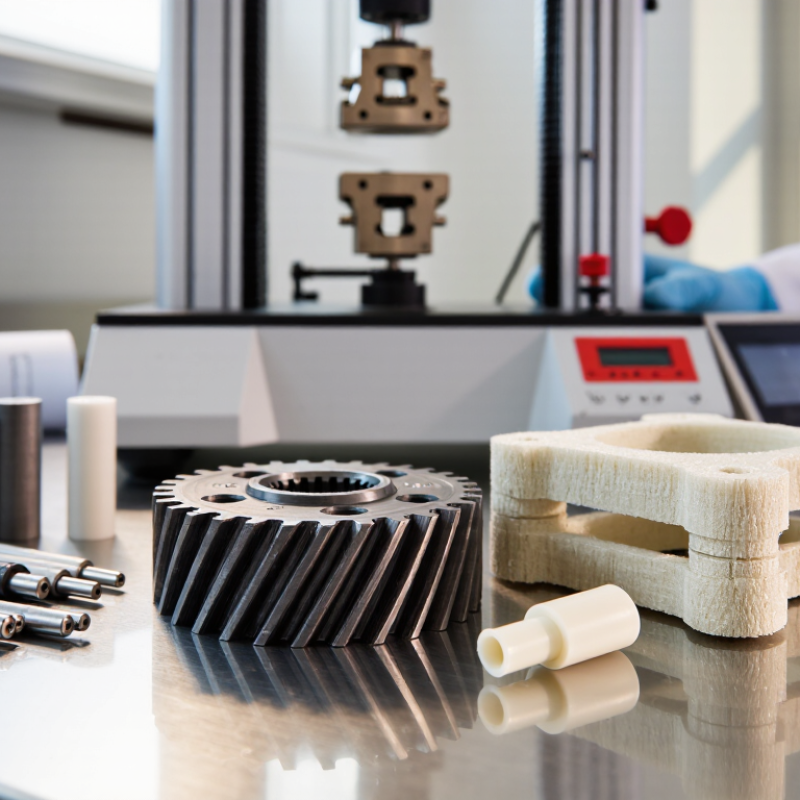
A datasheet may show a tensile strength near 100 MPa, yet actual parts can perform differently. Mold orientation, moisture, surface finish, load cycles, and sterilization may change results. ISO 527, ISO 178, ASTM D638, and ASTM D695 provide valuable test frameworks, but laboratory data cannot fully reproduce every service environment. That is where material selection becomes practical engineering.
The best choice for 2026 should therefore balance temperature, chemical exposure, mechanical loading, compliance needs, manufacturing method, and total cost. This conclusion is less convenient than choosing the strongest grade. It is also more reliable. Each application deserves verification through supplier certificates, traceability, and representative testing before production approval.
What Is the Best PEEK Material for 2026?
PEEK Material Basics and Its Key Performance Criteria for 2026
PEEK is not simply a high-temperature plastic. In 2026, material selection should begin with the service environment. Standard PEEK grades typically show a glass-transition temperature near 143°C and a melting point near 343°C. Their continuous-use temperature often approaches 250–260°C, depending on loading and design. These figures are useful, but they can mislead without test conditions.
Grand View Research estimates that the global PEEK market reached about USD 1 billion in 2023, with strong growth expected through 2030. This demand reflects advanced applications, not universal suitability. Engineers should compare tensile strength, creep resistance, wear rate, chemical exposure, and dimensional stability. ASTM D638, ASTM D3418, and ISO 527 provide useful testing frameworks. Still, a laboratory result cannot fully represent a vibrating pump, a sterilization cycle, or a dusty sliding seal.
Filler selection matters. Carbon fiber can improve stiffness and reduce creep, while graphite or ceramic fillers may support sliding performance. However, fillers can increase brittleness, electrical conductivity, or counterface wear. That trade-off deserves attention. For medical applications, biocompatibility evidence and ISO 10993 testing remain essential. For aerospace or electrical uses, traceability and flame performance may outweigh maximum tensile strength. A mistake I still see is choosing the strongest grade first. The best PEEK material is often the one that survives the complete duty cycle, not the one with the highest datasheet value.
| PEEK Material Type | Typical Composition | Density (g/cm³) |
Tensile Strength (MPa) |
Tensile Modulus (GPa) |
Continuous Use Temperature (Approx.) |
Wear and Friction Behavior | Recommended Selection Focus |
|---|---|---|---|---|---|---|---|
| Unfilled PEEK | Virgin polyether ether ketone without reinforcing fibers or solid lubricants | Approximately 1.30 | Approximately 90–105 | Approximately 3.5–4.2 | Approximately 250 °C in continuous service; short-term exposure may be higher depending on design and environment | Good inherent wear resistance and low moisture absorption; generally better for sliding against softer or well-finished counterfaces than heavily loaded fiber grades | Best for balanced mechanical performance, toughness, electrical insulation, chemical resistance, and easier machining |
| Glass-Fiber-Reinforced PEEK | Typically 20–30% short glass fiber by weight | Approximately 1.50–1.55 | Approximately 110–150 | Approximately 6–9 | Approximately 250 °C, subject to load, orientation, and thermal aging | Improved dimensional stability and compressive stiffness; can be more abrasive to mating components than unfilled PEEK | Best for structural parts requiring higher stiffness, lower thermal expansion, and improved load retention |
| Carbon-Fiber-Reinforced PEEK | Typically 20–30% short carbon fiber by weight | Approximately 1.40–1.45 | Approximately 130–170 | Approximately 10–16 | Approximately 250 °C, with performance dependent on fiber orientation and stress level | Very good stiffness-to-weight ratio, creep resistance, and dimensional stability; often selected for demanding bearing and structural applications | Best general choice when stiffness, low thermal expansion, fatigue resistance, and weight reduction are priorities |
| Carbon-Fiber and PTFE-Modified PEEK | Carbon fiber combined with a solid lubricant such as PTFE; exact formulation varies | Approximately 1.40–1.50 | Approximately 100–150 | Approximately 7–12 | Approximately 250 °C, depending on the lubricant system and load | Optimized for low friction and reduced wear in dry-running or marginally lubricated service; mating-surface compatibility remains important | Best for bushings, thrust washers, seals, and other sliding parts where friction and wear are more important than maximum strength |
| Bearing-Grade PEEK Compound | PEEK containing a formulation of reinforcing fibers and solid lubricants | Approximately 1.40–1.60 | Approximately 90–150 | Approximately 5–12 | Approximately 200–250 °C, depending on the compound and pressure-velocity conditions | Designed for lower wear, controlled friction, and improved resistance to pressure-velocity loading | Best when tribological performance, maintenance reduction, and dimensional consistency are the primary requirements |
| High-Purity PEEK | PEEK manufactured with controlled contamination, extractables, and processing conditions | Approximately 1.30–1.32 | Approximately 90–105 | Approximately 3.5–4.2 | Approximately 250 °C, subject to application validation | Similar basic wear behavior to unfilled PEEK; the main advantage is cleanliness and controlled chemical compatibility | Best for fluid handling, semiconductor processing, analytical equipment, and applications with strict cleanliness requirements |
| Medical- or Implant-Grade PEEK | PEEK produced under controlled manufacturing and traceability requirements for specific healthcare uses | Approximately 1.30–1.32 | Approximately 90–105 | Approximately 3.5–4.2 | Approximately 130–250 °C depending on sterilization method and validated design limits | Good chemical resistance and fatigue performance; sterilization exposure and surface condition must be validated | Best when biocompatibility, sterilization resistance, traceability, and regulatory documentation are essential |
| Electrically Conductive PEEK | PEEK modified with conductive carbon-based fillers | Approximately 1.35–1.55 | Approximately 80–140 | Approximately 4–12 | Approximately 200–250 °C, depending on filler content and design stress | Wear performance varies with filler system; conductive fillers may increase stiffness but can affect surface finish and mating-part wear | Best for electrostatic discharge control, conductive components, sensors, and parts requiring controlled electrical resistance |