How to Choose the Right PEEK Applications?
Choosing the right PEEK material starts with the conditions it must face, not just a supplier’s grade name. Temperature, sustained load, friction, chemical exposure, and sterilization can each change what “right” means. Small details matter. A warm-motor bearing may need different wear behavior from an insulator in a dry enclosure. Both may use PEEK, yet their failure risks differ. That is the practical starting point for evaluating peek applications.
Unfilled PEEK, glass-fiber-reinforced grades, and carbon-fiber-reinforced grades offer different combinations of strength, stiffness, wear behavior, and dimensional stability. Fillers can help in some designs, but they may also affect friction, counterface wear, or machining. There is no universally best grade. It is easy to focus on a headline temperature rating and overlook continuous load, part thickness, or how heat escapes in the finished assembly. I have seen those quieter details deserve more attention than expected.
A reliable selection process connects material data to the actual part and its manufacturing method. Review current technical datasheets, then check whether the stated conditions match your operating environment. Where failure would be costly, test representative parts under realistic heat, load, chemical contact, and motion. A short trial may reveal a problem that a catalog table cannot. This guide explains how to compare PEEK options, ask suppliers specific questions, and narrow the choices before committing to production.
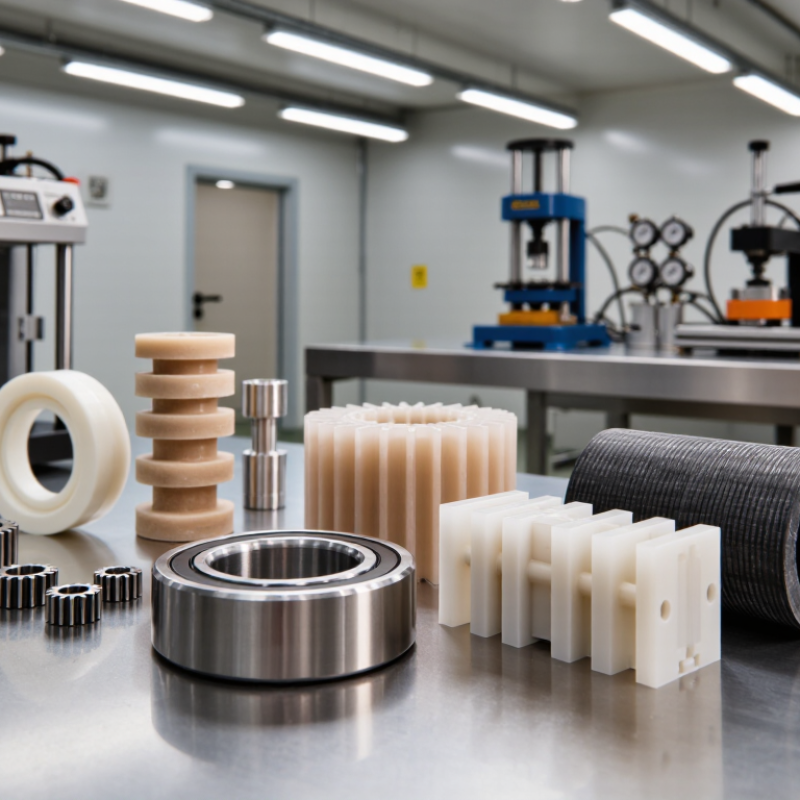
Understanding PEEK and Its Core Properties
PEEK is a semi-crystalline thermoplastic valued for retaining strength under heat and repeated mechanical stress. CAMPUS polymer data sheets report a melting point near 343°C and a glass-transition temperature around 143°C; typical unfilled grades have a density close to 1.30 g/cm³. Tensile values often fall around 90–100 MPa when measured using ISO 527 methods. Numbers vary. Grade, processing, and test conditions all affect results, so a datasheet figure is a starting point, not a design guarantee.
In practice, those properties matter when a component faces hot fluids, friction, or frequent cleaning. A bearing inside a warm pump, for example, needs wear resistance as well as dimensional stability. PEEK can also resist many chemicals, but compatibility depends on concentration, temperature, and exposure time. That matters. A reported continuous-use temperature near 250°C does not mean every loaded part can operate there indefinitely. Check creep, moisture, and the effects of machining on fit. Engineers sometimes overlook the last detail. A small clearance change can cause trouble in a precision assembly. For a real selection, compare the exact grade’s technical data with the service conditions and verify performance through application-specific testing.
How to Choose the Right PEEK Applications? — Understanding PEEK and Its Core Properties
PEEK combines a high glass-transition temperature with a high melting point and can typically serve in continuous use at temperatures up to about 250°C. These reference temperatures are approximate and vary with grade and test conditions. When selecting an application, also consider load, chemical exposure, wear, and the operating environment.
Matching PEEK Properties to Application Requirements
Matching PEEK properties to application requirements starts with the failure mode, not the material’s reputation. The CAMPUS plastics database lists typical unfilled PEEK density near 1.30 g/cm³ and melting point near 343°C. Treat these as reference values; fillers and test conditions can change performance. A pump bush may need wear resistance and chemical compatibility more than maximum tensile strength. A thin electrical connector may depend more on insulation and dimensional stability.
Tips: Write down the real temperature, load, exposure time, and cleaning fluid. Then check creep, wear, and chemical-resistance data for the specific grade. A short trial under actual operating conditions can reveal issues a datasheet misses.
Heat is not the whole story. PEEK’s stiffness and strength can decline under sustained load, even below its melting point. For a hot bearing, check pressure–velocity limits and lubrication, not temperature alone. For a medical or food-contact component, verify the required compliance and traceability separately; “PEEK” alone does not establish suitability. I would also question oversized safety margins: they can add cost without solving the actual failure. Still, early screening is only a start. Confirm dimensions, tolerances, and service life through testing against the application’s operating conditions.
Assessing Operating Conditions and Performance Needs
A PEEK part should be chosen for its actual working environment, not just its material data sheet. Record the normal temperature and the highest short-term spike. A seal near a hot process line may face brief heat surges that a steady-state test does not reveal. Note the chemicals, cleaning agents, and exposure time, too. Compatibility depends on the full combination of conditions.
Mechanical demands matter just as much. Estimate the load, how long it stays applied, and whether the part moves against another surface. A bracket under constant force may slowly deform, even when it never approaches its short-term strength limit. A sliding component needs attention to friction, wear, counterface material, and lubrication. Small details count. Surface finish can change performance.
Check dimensions, moisture exposure, and manufacturing tolerances before settling on a design. Tight fits can become unreliable if operating heat causes expansion or a molded part varies slightly from batch to batch. It is easy to focus on peak temperature and overlook repeated thermal cycles. That is a common gap. Test a representative sample under realistic load, temperature, and chemical exposure where practical. Results may challenge the initial assumptions, and that is useful. A controlled trial can reveal whether the chosen grade and geometry meet the application’s needs.
Comparing PEEK Grades and Processing Options
How to Choose the Right PEEK Applications?
Comparing PEEK Grades and Processing Options
Start with the load, temperature, and contact surface—not the grade name. Unfilled PEEK offers a useful balance of strength and toughness, while glass-filled grades can improve stiffness and dimensional stability. Carbon-fiber reinforcement can increase stiffness and help reduce thermal expansion, but may create directional properties. That distinction is easy to miss. Kurtz and Devine’s review in Biomaterials (2007) reports PEEK’s glass-transition temperature at about 143°C and melting point near 343°C. These figures help frame processing limits, but do not replace grade-specific data. Not always.
Processing changes the choice. Injection molding suits complex, repeatable parts, but requires high melt temperatures and careful mold-temperature control. Extrusion works well for continuous shapes such as rods and tubes. Compression molding or machining from molded stock may fit larger, simpler components or low-volume production. Reinforced grades can wear tools faster, so factor in machining time and surface finish. A caveat: generic property values are not design guarantees. Check the supplier’s technical data, test the finished part under its actual load and temperature, and confirm dimensions after cooling. Small details, like a thin rib or sharp corner, can alter both flow and stress. I would double-check those before settling on a grade.
Evaluating Cost, Compliance, and Long-Term Reliability
A PEEK part may look simple, yet its operating conditions determine whether the material justifies its higher cost.
Map the real loads, temperatures, chemicals, and cleaning cycles before selecting a grade. A seal exposed to repeated heat cycles needs different evidence than a lightly loaded bracket. That matters. Compare total cost, not resin price alone. Machining time, scrap rates, inspection, and replacement access can outweigh a lower initial quote. Ask for data on the exact grade and manufacturing process, then check that it matches your design. A small prototype run can reveal warping or difficult tolerances before production. It may feel slow. It can prevent expensive surprises.
Compliance requirements depend on the application and destination market. Confirm that the grade’s documentation covers the intended contact, temperature, and processing conditions; a generic material certificate may not answer every question. Keep lot traceability and inspection records with the part specifications. For long-term reliability, test representative components under realistic conditions, including thermal cycling, vibration, and exposure to cleaning agents where relevant. Heat and moisture can change performance over time, so accelerated testing should support—not replace—field evidence. Use measured data to set inspection intervals and replacement criteria. I would not assume that a successful short test guarantees years of service; the operating environment may be less predictable than the lab.